In recent years, working in economic consulting and data analysis, I have repeatedly encountered a structural limitation: the difficulty of accessing economic data that is consistent, well-structured, and readily usable, particularly in the context of small economies.
San Marino represents a clear example.
Despite the presence of an established statistical office, Statistica.sm, and its integration within the broader Italian and European framework, available data remains fragmented, dispersed across multiple sources, and not immediately suited for systematic analysis.
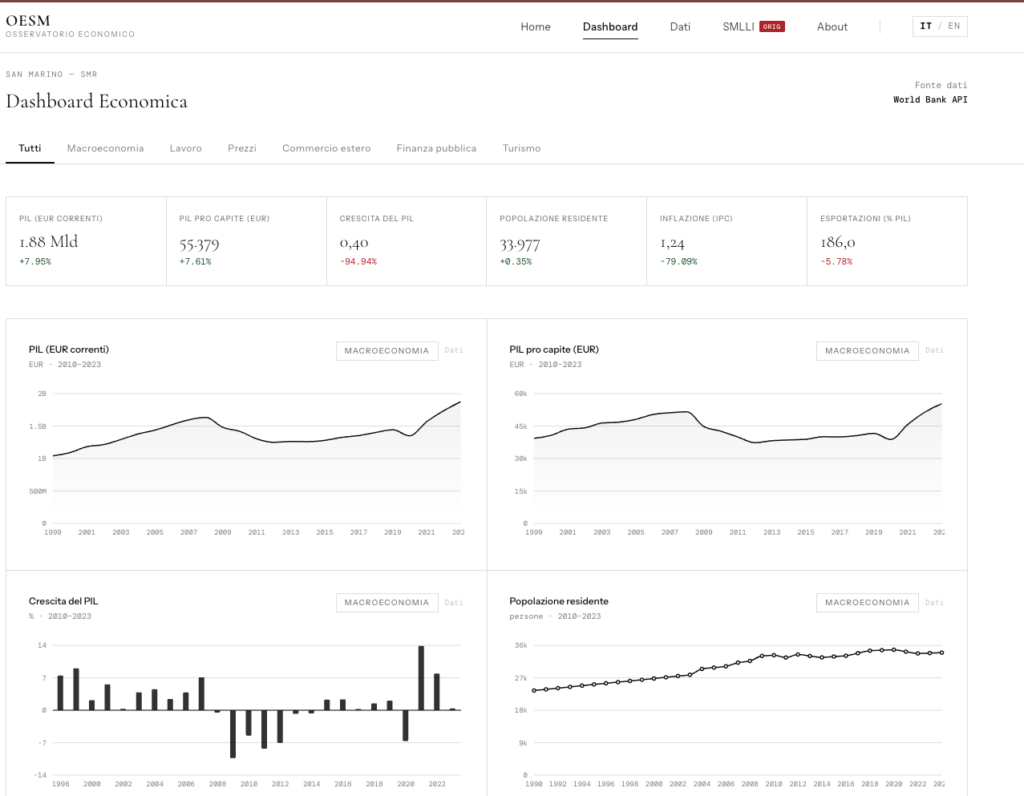
In response to this, I developed OESM: Osservatorio Economico di San Marino, a dedicated data infrastructure designed to provide a coherent and structured view of the country’s economic dynamics.
A structured approach to economic data
OESM is built as a unified data layer that consolidates and standardizes information from international institutions and national statistical sources, including the national statistical office, the World Bank, and the International Monetary Fund.
Data is integrated, normalized, and organized into consistent time series, allowing for direct comparability across indicators and over time.
This structure enables a more immediate transition from raw data to interpretable economic analysis, reducing the need for manual reconciliation across heterogeneous datasets.
Beyond data: constructing analytical indicators
A key component of OESM is the development of original indicators aimed at capturing economic dynamics that are not directly observable through standard statistics.
Among these, the San Marino Labour Income Leakage Index (SMLLI) provides a synthetic measure of cross-border labour income flows.
The index estimates the net balance between income generated within San Marino by non-resident workers and income earned abroad by residents, incorporating additional components such as remittances and tourism-related inflows.
By consolidating these elements into a single metric, SMLLI offers a structured perspective on the extent to which labour income generated within the economy is retained domestically or redistributed across borders, an aspect particularly relevant for small, highly interconnected economic systems.
An evolving analytical framework
OESM operates as a continuously evolving system, designed to expand in terms of data coverage, methodological depth, and analytical capabilities.
Its structure allows for the progressive integration of new datasets and the refinement of existing indicators, with the objective of providing an increasingly robust foundation for economic analysis on San Marino.
In complex economic environments, the quality of analysis ultimately depends on the quality and usability of underlying data.
By structuring and consolidating dispersed information into a coherent analytical framework, OESM contributes to improving the way economic dynamics can be observed, interpreted, and ultimately understood.